
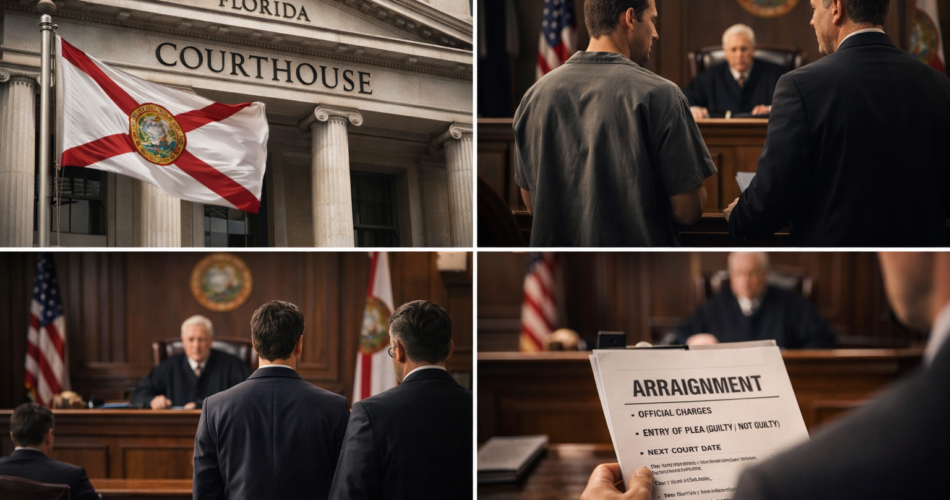
Understanding The Arraignment Process in Florida
The Arraignment process in Florida is the stage of a criminal case where the court formally advises the defendant of the charges and asks for a plea. In many cases, this is the first time the defendant appears in court after the initial arrest and first appearance process. Although arraignment is usually brief, it matters because it confirms that the case is moving forward and establishes how the defendant intends to respond to the allegations.
During a Florida arraignment, the judge typically calls the case, identifies the defendant, and confirms the pending charge or charges. The court may state the offense, provide or confirm that the defendant has received the charging document, and explain certain rights. The defendant is then asked to enter a plea, usually guilty, not guilty, or no contest, depending on the case and advice of counsel.
Many people expect arraignment to be a full hearing on the facts, but that is not what usually happens. Witnesses generally do not testify, evidence is not fully presented, and the court does not decide guilt or innocence at this stage. Instead, the hearing focuses on notice of the charges, the plea, and basic case management issues that will shape the next steps.
- The court identifies the defendant and the case.
- The charges are announced or confirmed.
- The defendant is asked to enter a plea.
- The court may address counsel, bond issues, or scheduling.
- A future court date may be set if the case does not resolve.
Timing and Location Details of the Arraignment process in Florida
How soon after arrest the Arraignment process in Florida occurs can depend on the charge, the court’s schedule, whether the defendant remains in custody, and whether the case proceeds by information, indictment, citation, or notice to appear. In general, arraignment does not always happen immediately after arrest. A defendant may first go through an initial appearance or first appearance, and the arraignment may take place later once formal charges are filed and the case is placed on the court’s calendar. Arraignments in Florida are typically held in the criminal division of the court handling the case.
The exact courtroom, courthouse, or remote appearance process will depend on where the charges were filed and the level of offense involved. Some defendants appear in person, while others may appear by video in limited circumstances if the court permits it.
The notice of hearing, clerk records, or defense counsel usually provide the exact date, time, and courtroom details. Because scheduling can change, defendants should never assume that a court date remains the same without checking.
Continuances, calendar changes, or rescheduling may occur, especially in busy criminal dockets. Missing an arraignment can create serious problems, including a warrant or additional bond complications, so confirming the hearing date and location in advance is essential.
- The arraignment may occur days or weeks after arrest, depending on the case.
- The hearing is usually held in the court assigned to the criminal charge.
- Some courts may allow certain appearances to be waived or handled by counsel.
- Defendants should verify the hearing date, time, and courtroom before appearing.
Explaining Plea Options Available at Florida Arraignments
At the Arraignment process in Florida, the defendant is generally asked to enter a plea. The most common pleas are not guilty, guilty, and no contest. A not guilty plea means the defendant contests the charge and requires the prosecution to prove the case.
A guilty plea is an admission to the offense. A no contest plea means the defendant is not contesting the charge, even if not making a direct factual admission in the same way as a guilty plea. In many criminal cases, a not guilty plea is entered at arraignment so the defense can review the evidence, investigate the facts, evaluate possible defenses, and consider whether negotiations are appropriate.
Pleading guilty or no contest at arraignment may end important rights, including the right to a trial, so that decision should be made carefully and usually only after legal advice. If a defendant refuses to enter a plea, the court may enter a not guilty plea on the defendant’s behalf so the case can continue. A plea entered at arraignment is not always the final plea in the case.
In many situations, a defendant can later change a plea, subject to court rules and timing. For example, a defendant may begin with a not guilty plea and later resolve the case through a negotiated plea. Whether a plea can be changed, and under what conditions, depends on the procedural posture of the case and any agreement already accepted by the court.
- Not guilty preserves the right to challenge the charge and move the case forward.
- Guilty may lead directly to sentencing or a later sentencing date.
- No contest may resolve the case without contesting the charge.
- If no plea is entered, the court may enter a not guilty plea for the defendant.
How Bail and Bond Are Handled in the Florida Arraignment process
Bail and bond issues are not always first decided at arraignment because they are often addressed earlier, such as at the first appearance. Still, bond conditions may come up during the Arraignment process in Florida if the defendant remains in custody, requests a modification, or if the court needs to revisit release terms. The judge may review the existing bond amount, nonmonetary conditions, or whether any hold or restriction affects release.
When deciding bail or bond-related issues, the court may consider factors such as the seriousness of the charge, prior criminal history, record of appearing in court, ties to the community, public safety concerns, and whether the defendant is accused of violating any existing court order. In some cases, bail may be denied or heavily restricted, particularly when the law allows detention or enhanced conditions based on the nature of the allegations. If bail remains in place after arraignment, the defendant may be able to post the required amount or use a bond company where permitted.
A bondsman generally helps secure release by posting a bond for a fee and under contractual terms. If the defendant cannot afford bail, counsel may later request a bond reduction or a change in conditions. In practice, the timing of release after posting bail depends on jail processing, verification procedures, and administrative delays.
- Bond may already be set before arraignment, but it can still be reviewed.
- The court may impose conditions such as no-contact provisions or travel limits.
- A bond company may assist with posting bail in eligible cases.
- If bail is unaffordable, a later motion to reduce bond may be possible.
The Role of Legal Representation During the Arraignment process in Florida
Legal representation can make a meaningful difference during the Arraignment process in Florida, even though the hearing itself is often short. A defense lawyer can explain the charges, evaluate the best plea to enter, determine whether appearance can be waived in some situations, and protect the defendant from making statements that could complicate the case later. What seems like a routine hearing can still affect bond, scheduling, and strategic decisions.
A defendant may be able to request a public defender during or around the arraignment process if the defendant qualifies financially and the case carries the right to appointed counsel. The court may ask questions about income, assets, and eligibility before appointing counsel. In other cases, the defendant may retain private counsel before the hearing so the attorney can appear, advise on plea entry, and begin building the defense immediately. Although a person can sometimes appear without a lawyer, self-representation carries real risk.
Defendants may not understand the charging document, available defenses, plea consequences, or the effect of a statement made in open court. Even if the arraignment appears procedural, it is still part of a criminal prosecution, and early legal advice often improves decision-making and helps avoid unnecessary mistakes.
- A lawyer can explain the charge and recommend how to plead.
- Counsel may help with bond issues, scheduling, and protecting legal rights.
- A public defender may be available if the defendant qualifies.
- Early representation helps prepare for discovery, motions, and negotiations.
Defendant Rights and Courtroom Conduct in Florida Arraignments
Defendants have important rights during Florida arraignments. These include the right to be informed of the charges, the right to counsel, the right to remain silent about the underlying facts of the case, and the right to due process. If a plea of not guilty is entered, the defendant also preserves the right to require the prosecution to prove the charge through the criminal process.
Understanding these rights matters because a rushed or uninformed decision at arraignment can have lasting consequences. Courtroom conduct is also important. Defendants should dress neatly, arrive early, remain respectful, and speak only when asked by the judge or after conferring with counsel. Interrupting the court, arguing with the judge, or trying to explain the facts of the case without legal advice can hurt more than help.
Family members may often attend, and victims may also have rights to be present, but the defendant should remain focused on following court instructions. A common mistake is assuming arraignment is the right time to tell the whole story. Usually, it is not. Statements made in court may become part of the record and could later be used against the defendant. The safer course is to address only what is necessary for the hearing, enter the appropriate plea, and let counsel handle factual and legal arguments at the right stage of the case.
- You have the right to know the charges against you.
- You have the right to legal representation.
- You generally do not need to discuss the facts of the case at arraignment.
- Professional and respectful conduct helps the hearing proceed smoothly.
Handling Charges and Case Information at the Florida Arraignment
One purpose of the Florida arraignment is to make sure the defendant understands what charges are pending. The charging document may be an information, indictment, citation, affidavit, or another formal accusation depending on how the case began.
If the defendant does not understand the wording of the offense, the level of the charge, or the possible consequences, that should be raised through counsel or addressed with the court in an appropriate way. Defendants often want to know whether additional charges can appear after arraignment. In some cases, charges may be amended, added, reduced, or dismissed later depending on the evidence and procedural rules.
Arraignment is not always the final word on the exact shape of the prosecution. That is one reason defense counsel typically treats arraignment as an opening stage rather than the final definition of the case. The defendant may receive or confirm receipt of paperwork connected to the hearing, such as the charging document, notice of future court dates, bond conditions, or forms related to counsel.
The clerk’s office and defense attorney usually become important sources of records after arraignment. If there is confusion about what was filed or what the next hearing is, obtaining copies promptly can prevent missed deadlines and misunderstandings.
- Arraignment confirms the formal charges currently pending.
- If you do not understand the charge, legal clarification is important.
- Charges can sometimes be changed later in the case.
- Court paperwork from arraignment should be kept and reviewed carefully.
What to Expect in the Post-Arraignment and Pretrial Process in Florida
After the Arraignment process in Florida, the case usually moves into the pretrial phase. If the defendant entered a not guilty plea, the next steps often include obtaining discovery, reviewing police reports and other evidence, filing motions, participating in pretrial conferences, and discussing possible resolution options.
The next court date may be scheduled at or shortly after arraignment, and that date becomes very important for the progress of the case. Discovery is the process through which the defense receives and reviews the prosecution’s evidence. This may include witness statements, reports, recordings, photographs, and other materials required by law or court rule.
Once discovery is reviewed, counsel can better evaluate whether the case should be contested through motions and trial preparation or resolved through negotiation. In some cases, continuances may be requested if more time is needed to investigate or obtain records. Post-arraignment proceedings can vary widely from one case to another.
Some matters move quickly toward dismissal or a plea agreement, while others require extensive motion practice or trial preparation. The key point is that arraignment is usually not the end of the case. It is a procedural milestone that leads into the more substantive stages where evidence, defenses, negotiations, and strategy become central.
- The court usually sets another hearing after arraignment if the case remains open.
- The defense may request discovery and begin formal case review.
- Motions, negotiations, and pretrial conferences often follow.
- A continuance may be possible if additional preparation time is needed.
Special Circumstances in the Florida Arraignment process: Juveniles, Domestic Violence, and Multiple Charges Some cases involve special procedures or heightened concerns during the Arraignment process in Florida. Juvenile matters may follow different rules, privacy protections, and court structures than adult criminal cases.
A parent, guardian, or attorney may play a more direct role depending on the circumstances. Even when the hearing format looks similar, the legal consequences and procedural safeguards for juveniles can differ significantly from standard adult proceedings. Domestic violence allegations often bring stricter bond conditions and immediate court attention to safety-related issues.
The court may address no-contact provisions, residence restrictions, firearm-related concerns, or other protective conditions that affect the defendant right away. In these situations, it is especially important not to assume that ordinary communication or contact is allowed simply because the criminal case is still in an early stage. When a defendant faces multiple charges, the arraignment may involve reading or confirming several counts in the same case.
The defendant may enter a plea to each count, and the court may address whether all charges will proceed together. Multiple charges can affect bond, plea strategy, sentencing exposure, and pretrial planning. If a charge is dismissed at or before arraignment, the court may note that development, but other counts may still remain active.
- Juvenile cases may involve different procedural rules than adult cases.
- Domestic violence cases often include strict no-contact or safety conditions.
- Multiple charges can increase complexity and affect plea strategy.
- Dismissal of one charge does not necessarily end the entire case.
Administrative Procedures and Logistical Details of the Florida Arraignment process
The practical side of the Florida arraignment is often just as important as the legal side. Defendants should know how to find the hearing date, where to check for updates, what documents to bring, and whether counsel can appear on their behalf in the specific case.
Court notices, clerk records, jail information systems, and defense counsel are common sources for confirming scheduling details, but defendants should verify information rather than rely on assumptions. If an arraignment must be rescheduled, the proper approach is usually through a formal request, motion, or attorney communication with the court, not simply failing to appear. A postponement may be possible for valid reasons, but the court controls the calendar.
There is generally no separate fee just to appear for arraignment, although criminal cases can involve other costs, bond expenses, or later financial obligations depending on the outcome. It is also wise to keep a written record of every court date, condition of release, and document received. Save notices, ask for copies when needed, and follow all deadlines.
Administrative mistakes can quickly become legal problems in a criminal case. Even a straightforward arraignment can lead to serious consequences if a defendant misses a hearing, violates bond conditions, or fails to track what the court ordered.
- Confirm the arraignment date, time, and appearance requirements in advance.
- Bring identification and any court paperwork you have received.
- Do not miss the hearing without court approval or legal guidance.
- Keep copies of notices, bond terms, and future court dates.
Frequently Asked Questions
What are the key steps and considerations in the arraignment process in Florida?
The key steps in the Arraignment process in Florida usually include appearing before the court, confirming the pending charges, receiving or acknowledging the charging document, and entering a plea.
Important considerations include whether to plead not guilty, guilty, or no contest, whether bond conditions need attention, whether a lawyer should appear with you, and what the next court date will be. Defendants should also understand their right to remain silent about the facts, their right to counsel, and the importance of following all court instructions and bond conditions after the hearing.