
Florida DUI Defense Law: Overview and Strategy
Florida DUI defense law covers the legal definitions, procedures, and proven strategies for defending DUI charges. Knowing Florida's BAC limits, how law enforcement collects evidence, and the full range of possible legal defenses is essential. If you're facing a DUI, prompt action—especially with attorney guidance—can help you protect your rights, minimize penalties, and safeguard your future opportunities.
What To Know At A Glance
- Florida's legal BAC limit is 0.08% for adults, 0.04% for commercial drivers, and 0.02% for those under 21.
- You can be charged with DUI for alcohol, illegal drugs, or even prescription medications if they impair your faculties.
- Both criminal (jail, fines, probation) and administrative (license suspension, ignition interlock) penalties may apply.
- The legality of the traffic stop, field test accuracy, and adherence to police protocols are often central defense issues.
- Failing a chemical test isn't always determinative—defenses often challenge calibration, timing, or alternative explanations.
- Strict deadlines apply to challenge license suspension; delay may cost you key rights and evidence.
- A DUI can impact employment (especially for CDL holders) and stays on your record—there is no expungement under current Florida law.
Key Definition
DUI (Driving Under the Influence)
DUI in Florida means operating or being in actual control of a vehicle while your normal faculties are impaired by alcohol, drugs, or a combination, or with a BAC at or above the legal threshold. Impairment can be proven even if BAC is below the numeric limit.
Why Florida DUI Defense Matters
People search about Florida DUI defense because the stakes are high if you’re arrested or investigated for driving under the influence. Even a first-time conviction can disrupt your freedom, finances, and reputation for years. Understanding your rights and options is crucial to avoiding harsh criminal and administrative consequences.
Concerns Over Legal Consequences of DUI Arrests in Florida
A DUI arrest triggers immediate legal and administrative processes, often leading to permanent records and loss of driving privileges. Many worry about job loss, insurance spikes, and the real-life impact a single stop can have. Anxiety and social stress often follow, underscoring the need for informed legal advice.
Protecting Your Rights and Minimizing Penalties
Every fact—from the officer’s justification for the stop, to the test result’s reliability—can drastically affect your case outcome. Smart defense aims to uphold your constitutional protections and reduce legal fallout wherever possible.
Navigating Complex DUI Laws and Police Practices
Florida DUI law is full of technicalities—and seasoned defense attorneys know that mistakes during police stops, testing, or paperwork may open critical opportunities to challenge the state’s case.
High Stakes: Impact on Driving Privileges, Employment, and Criminal Record
A DUI can lead to automatic license suspension, job complications (especially for commercial drivers), and a permanent criminal record. Early legal engagement is key to defending your case and protecting your long-term interests.
Legal Foundations of DUI in Florida
Understanding the legal framework for DUI is the backbone of any solid defense. Definitions, limits, and who is affected are spelled out in state law and shape every aspect of your case.
Florida’s Legal Blood Alcohol Content (BAC) Limits
For adults, 0.08% BAC is the legal limit; it’s stricter for commercial drivers (0.04%) and nearly zero for those under 21 (0.02% BAC), reflecting Florida’s zero-tolerance stance for minors.
Defining DUI and the Difference Between DUI and DWI
'DUI' is the only statutory term in Florida, covering all impaired driving charges. Though some states use 'DWI,' Florida applies only DUI statutes.
Substances That Can Lead to DUI Charges
Alcohol, recreational drugs, and even legal prescription or over-the-counter drugs may all result in a DUI if they impair your ability to drive safely.
DUI Laws Specific to Minors and Commercial Drivers
Minors are charged at much lower BAC thresholds. CDL holders also face heightened scrutiny—both face severe penalties beyond those imposed on typical adult drivers.
Overview of Drug-Impaired Driving Laws
If your faculties are impaired by drugs—legal or not—you can be prosecuted for DUI even with little to no alcohol detected. Officers look for behavioral and physical signs as well as lab results.
Police Procedures and What to Expect During a DUI Stop
Police follow detailed protocols during DUI investigations. Knowing these processes—and the common slip-ups—can reveal openings for your defense attorney to challenge evidence.
Establishing Probable Cause for a DUI Traffic Stop
An officer needs a legal reason (like a moving violation) to pull you over, then further justification to pursue DUI testing based on your observed behavior.
Field Sobriety Tests: Process and What Officers Look For
Officers use standardized field sobriety tests tailored to detect impairment. However, results can be tainted by poor instructions, health issues, or roadside distractions.
Breathalyzer and Blood Tests: Rights and Refusal Consequences
You can refuse chemical tests, but you’ll face an automatic license suspension and your refusal may be used as evidence in your court case.
Implied Consent Law and Its Role in DUI Cases
By driving in Florida, you automatically consent to chemical testing upon lawful arrest. Refusing these tests brings immediate administrative penalties.
DUI Checkpoints: Legality, Procedures, and Your Rights
DUI checkpoints are lawful under strict guidelines. While you must cooperate, you still retain the right to avoid self-incrimination and to ask for an attorney.
Arrests Without Breathalyzer Tests: How and When They Occur
Police may arrest you for DUI based solely on field tests or officer observations if breath or blood results aren’t available or you refuse testing.
Common Penalties and Consequences for DUI Convictions
A Florida DUI conviction triggers a cascade of criminal penalties and administrative fallout. The effects often last far beyond your court date.
Penalties for First-Time and Repeat DUI Offenses
First offenders typically face fines, a suspended license, probation, potential jail time, and mandatory education. Higher BAC readings, accidents, or repeat offenses escalate these penalties quickly.
License Suspension Periods and Reinstatement Requirements
Suspension length and reinstatement are tied to prior DUI history, refusal of testing, and timely completion of courses and administrative requirements.
Ignition Interlock Device Mandates
Higher BAC convictions or repeat offenses almost always require ignition interlock devices—expensive and cumbersome conditions for reinstating driving privileges.
Fines, Jail Time, and Probation Terms
For a first DUI: $500–$1,000 fines, up to 6–12 months’ probation, and possible jail. Repeat or aggravated cases can mean harsh sentences and steeper fines.
Impact on Car Insurance and Professional Licenses
Insurance rates surge, with risk of cancellation. If your job requires a clean record or active license—such as healthcare, teaching, or security work—a DUI jeopardizes your livelihood.
Penalties Specific to Commercial Drivers
Commercial drivers risk immediate loss of their CDL for even a first offense—regardless of whether the incident happened on or off the job.
DUI Education and Treatment Programs: Mandatory or Optional?
DUI school is usually required for first offenders. High BAC or additional charges often bring mandatory substance abuse treatment.
Key DUI Defense Strategies in Florida
Strategic DUI defense is never one-size-fits-all. Effective attorneys scrutinize facts, evidence, and police conduct for every potential angle.
Challenging Probable Cause and Traffic Stop Legality
Your criminal defense attorney may move to suppress evidence if police lacked a valid reason to stop or detain you, citing controlling case law or prior procedural rulings.
Questioning Field Sobriety and Breathalyzer Test Validity
Field and chemical tests must be administered per strict standards. Defense lawyers often scrutinize training logs, environmental conditions, or instrument maintenance records to expose errors.
Contesting Blood Alcohol and Drug Test Results
Scientific defenses might attack test calibration, chain of custody, or timing. Experienced attorneys regularly argue test results were skewed by improper calibration, referencing lab science and precedent cases.
Using Procedural Errors and Police Misconduct as Defense
Failure to Mirandize, incomplete warnings, or inconsistencies in paperwork can provide strong grounds to suppress key evidence or push for dismissal.
Medical Conditions, Prescription Drugs, and Alternative Explanations
Medical issues—such as diabetes, GERD, or medication effects—may have caused symptoms misinterpreted as impairment or produced false positives on tests.
The Role of Witness Statements and Expert Testimony
Independent witnesses and defense experts can contest police accounts, explain unusual results, or highlight flaws in the prosecution’s scientific evidence.
Defenses Specific to Drug-Related DUI Charges
Drug DUIs are complex—defense often centers on accuracy of toxicology reports, evaluation protocols, and whether symptoms of impairment truly existed.
When and How to Use Plea Bargains Effectively
Plea deals may limit your penalties or avoid jail—especially when the facts are marginal or the prosecution’s case shows weakness. Your attorney can advise if it’s the best course based on your situation.
Navigating the DUI Court Process
A DUI case moves through several distinct phases. Understanding these steps and what to expect empowers you to protect your rights.
What to Expect at Your DUI Court Hearing
At arraignment, charges are read and you enter a plea. Your lawyer may request bail, seek discovery, or schedule further hearings to contest the evidence.
Timeline and Stages of DUI Court Proceedings
A typical DUI case includes arraignment, evidence and discovery, pretrial motions, plea negotiations, trial, and sometimes appeal.
Importance of Legal Representation and When to Hire an Attorney
Early legal help is vital. A defense attorney can preserve evidence, spot government missteps, and build the strongest possible strategy for your case.
Possibility of Resolving Cases Without Trial
Many DUI cases settle without trial through motions, plea bargains, or diversion. Each case must be analyzed on its merits and risks.
Consequences of Pleading Guilty and Withdrawing Pleas
A guilty plea brings instant sentencing and a reportable conviction. Withdrawing a plea is rare and only allowed if procedural missteps or unfairness can be shown.
Role of Specialized DUI Courts and Programs
Some counties offer special DUI courts focused on treatment or second-chance programs. Eligibility depends on your case facts and prior record.
Sentencing Factors and Appeals Process
Sentencing hinges on prior offenses, BAC, aggravating details, and court compliance. Appeals only review legal errors—not facts or guilt.
License Suspension, Hardship Licenses, and Driving Privileges
Your driving privileges are immediately at risk following a DUI arrest in Florida. To retain or restore your license, you must act quickly and comply with many requirements.
Timing and Notification of License Suspension After DUI Arrest
Typically, administrative suspension starts 10 days post-arrest. You must request a hearing promptly—otherwise, suspension begins automatically.
Driving During Suspension and Potential Legal Risks
Driving on a suspended license is a crime itself and risks hefty penalties—including jail, fines, and longer suspension.
Obtaining a Hardship License: Eligibility and Application Process
You may qualify for a hardship license—allowing for work or medical travel—by enrolling in DUI school and proving serious need.
Length of Suspension for First and Subsequent Offenses
First-time suspensions run 180 days–1 year. Repeat offenders or those with test refusals face multi-year suspensions and stricter review.
Avoiding or Reducing Suspension Through Legal Means
Timely legal action and evidence challenges may preserve or shorten your suspension—especially if procedures were not followed.
Reinstatement Procedures and Costs
Reinstatement means paying all fines, proof of insurance (SR-22/FR-44), and finishing court-mandated programs. Costs add up—prepare to document everything.
Specific Rules for Commercial Driver’s License (CDL) Holders
CDL holders can permanently lose commercial driving privileges, even for a DUI in a private vehicle. Deadlines and appeal rules are extremely strict.
DUI Probation and Treatment Programs
Probation and substance treatment are frequent elements in DUI sentencing. Compliance ensures you don’t face extra penalties or time behind bars.
Typical Terms and Compliance Requirements of DUI Probation
Regular reporting, random drug/alcohol tests, and payment of supervision fees are standard. Breaking any condition may trigger arrest or new charges.
Overview of DUI Treatment and Education Programs in Florida
First DUI? Count on mandatory DUI school—repeat or aggravated cases may require lengthy treatment at your expense.
Mandatory vs. Voluntary Programs: What Applies to Your Case
DUI school is mandatory for conviction. Voluntary efforts (treatment, AA, therapy) can sometimes tip the balance toward lenient outcomes.
Outpatient Treatment Options and Duration
Outpatient programs usually run several weeks or months, matched to needs and compliance. Completion may be monitored by court or probation officers.
Consequences of Non-Compliance and Potential for Early Termination
Missing classes or probation check-ins leads to violation charges—possibly jail or extended supervision. Full compliance sometimes earns early release.
Impact of Treatment Completion on License Reinstatement and Sentencing
Finishing DUI school or treatment is typically non-negotiable for getting your license back. Judges may also weigh it favorably during sentencing.
Common Mistakes to Avoid in Florida DUI Defense
A strong DUI defense avoids frequent errors—in both legal strategy and personal choices during your case.
Failing to Review and Request Key Evidence
Police reports, body and dash-cam video, and calibration records must be requested and examined early. Overlooking these key items can leave you defenseless.
Misunderstanding the Impact of Test Refusals
Refusing a breath or blood test usually hurts your case—bringing immediate penalties and creating uphill battles for your defense.
Overlooking the Importance of Stop Timing and Location
Legality hinges on when and where you were stopped. An illegal or pretextual stop can lead to total case dismissal—but you’ll lose this defense if not raised correctly.
Applying Generic Advice Without Florida Law Specificity
DUI law differs dramatically from state to state. Following generic or out-of-state guidance can jeopardize your defense in Florida.
Ignoring Medical and Prescription Drug Defense Opportunities
Documenting health or medication issues is vital—these may form a complete defense if symptoms or test results were misleading.
Delaying Critical Legal Counsel Engagement
Every day you wait to contact a DUI defense attorney risks lost footage, missed deadlines, and diminished negotiation leverage.
Key Takeaways for Effective Florida DUI Defense
Powerful Florida DUI defense starts with immediate action, careful review of facts, and state-specific strategies.
Early Legal Intervention Is Essential
Act quickly—engage a skilled defense attorney as soon as possible after your arrest.
Multiple Defense Angles Improve Case Outcomes
Effective defenses rarely rely on a single argument. Your attorney may pursue several lines of attack at once.
Mastering Florida-Specific DUI Law Nuances Is Crucial
Even minor procedural details in Florida law can change your case. Know the state’s unique rules and deadlines.
Avoid Common Pitfalls That Weaken Defense
Missing evidence or using the wrong legal advice can put your case at serious risk.
Tailoring Legal Strategy to Your Case Details
No two cases are the same. Your attorney should customize strategy to your history, evidence, and goals.
Related Resources on Florida DUI Law and Defense
Deepen your understanding of Florida DUI charges, processes, and defense techniques by exploring these focused resources:
Florida DUI Legal Definitions and Limits
Everything you need to know about DUI statutory definitions, BAC thresholds, and zero-tolerance policies.
DUI Arrest and Police Procedures in Florida
Step-by-step breakdown of standard police protocols, your rights, and what to expect during a Florida DUI stop.
DUI Penalties and Consequences in Florida
Comprehensive review of fines, jail terms, probation, and the long-term ripple effects of conviction.
DUI Court Process and Legal Representation in Florida
A practical walkthrough of Florida’s DUI court process, with tips on selecting the right defense counsel.
License Suspension and Reinstatement After DUI in Florida
How administrative suspensions, hardship licenses, and reinstatement work—plus practical advice for getting back on the road.
How The Main Paths Compare
| Defense Issue | What May Be Examined | Possible Legal Significance |
|---|---|---|
| Legality of Traffic Stop | Was there a valid traffic or investigative reason for the stop? Did the officer observe conduct that created probable cause? | If the stop was unlawful or unjustified, evidence gathered afterwards—such as sobriety or BAC test results—can be excluded. |
| Probable Cause for DUI Investigation | Was there articulable suspicion based on impairment cues, driving pattern, or field test performance? | Insufficient probable cause may make key evidence inadmissible, weakening or undermining the prosecution's case. |
| Standardized Field Sobriety Testing | Were field sobriety tests properly instructed and scored? Did the driver have medical or environmental factors that impaired performance? | Improper administration or unaffected performance may cast doubt on impairment, helping your defense. |
| Breathalyzer/Blood Test Procedures | Was the device properly calibrated? Did the operator follow correct sampling protocols? Was there a clear chain of custody? | Evidence of faulty calibration or protocol may allow the test results to be excluded or called into question. |
| Implied Consent/Refusal | Did the officer adequately warn of refusal consequences? Was the refusal documented at the correct time and manner? | Refusal generally brings automatic suspension, but a procedural slip can create a defense or support negotiation for mitigation. |
| Procedural and Evidentiary Issues | Did the officer read Miranda rights? Were all forms and reports properly completed and preserved? Was all relevant evidence disclosed? | Any omissions, errors, or misconduct can form strong grounds for motions to suppress or dismiss. |
| Negotiation and Treatment Participation | Did the defendant proactively enroll in DUI school or treatment, even before court-ordered? | Voluntary participation can favorably influence sentencing or negotiations. |
Step-by-Step Overview: Florida DUI Case Timeline
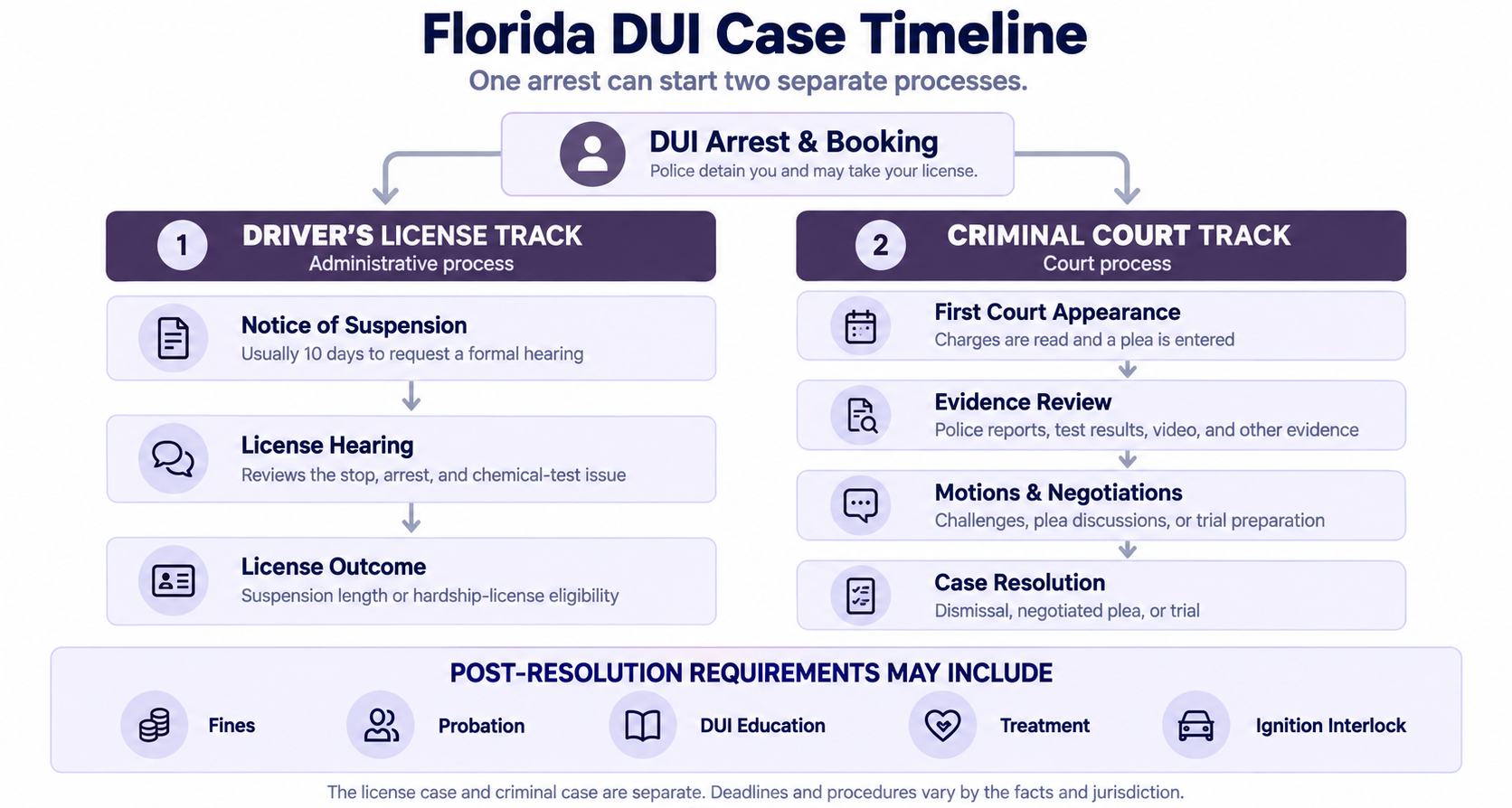
Read this as text
- DUI Arrest: Police detain you based on observations or traffic violation.
- Notice of Suspension: Officer issues a notice that triggers administrative suspension and a short deadline to request a review hearing.
- License Suspension Track: Administrative hearing determines if your license is suspended; deadlines are strict.
- Criminal Case Track: You have a court arraignment, followed by evidence discovery, motions, negotiations, and potential trial.
- Resolution: Case may resolve via dismissal, plea agreement, or trial outcome.
- Sentencing and Conditions: If convicted or after a plea, you must complete penalties like fines, probation, DUI school, and possibly ignition interlock.
- Reinstatement: Satisfy administrative and court requirements to restore your license and privileges.
Examples Of How This Can Play Out
Example Scenario 1
Situation: A first-time DUI offender is pulled over for drifting lanes, then fails two of three field sobriety tests. A breath test shows BAC just over 0.08%.
Likely Outcome: The defense attorney requests police dashcam footage, reviews breathalyzer maintenance logs, and investigates medical history (defendant takes prescription medication with possible side effects).
- Was the stop lawful and properly documented?
- Were sobriety tests administered per NHTSA standards and free of outside interference?
- Is there proof the breathalyzer was correctly calibrated and maintained?
- Could medication or a health condition explain test results or behavior?
- Was key evidence (reports, video) disclosed to the defense on time?
Example Scenario 2
Situation: A commercial driver (CDL) is charged with DUI after being stopped for a minor violation in their personal vehicle; breath test reads 0.05%.
Likely Outcome: Although BAC is below the standard adult legal limit, CDL administrative penalties apply. The defense examines probable cause for the stop, testing procedures, and possible negotiation for a reduced charge to preserve employment.
- Applicable BAC standards for CDL vs. non-CDL drivers
- Impact of any administrative or criminal proceeding on professional licensing
- Accuracy and chain of custody for breath test sample
- Defense opportunities based on procedural or technical errors
- Timing of administrative appeals and hearings to limit disqualification
Frequently Asked Questions
What is the legal blood alcohol content (BAC) limit in Florida?
The legal BAC limit in Florida is 0.08% for drivers age 21 and older, 0.04% for commercial drivers, and just 0.02% for drivers under 21 due to the state's zero-tolerance policy. If your BAC meets or exceeds these limits, you can be charged with DUI. However, you can still be charged if any level of alcohol or drugs impairs your normal faculties.
How does Florida define DUI under the law?
Florida defines DUI (Driving Under the Influence) as operating a motor vehicle while impaired by alcohol, drugs, or any combination, or with a BAC of 0.08% or higher. Impairment may be proven even if your BAC is below 0.08% if your faculties are adversely affected.
What are the penalties for a first-time DUI offense in Florida?
Penalties for a first-time DUI in Florida commonly include a fine of $500–$1,000, license suspension for 180 days to 1 year, possible up to 6 months in jail, probation, and mandatory DUI education. Additional penalties apply for high BAC, accidents, or minors in the vehicle.
Can I be charged with DUI in Florida if my BAC is below 0.08?
Yes. While 0.08% is the per se limit, you can be charged with DUI at any BAC level if drugs, alcohol, or a combination impair your ability to drive safely.
What are the consequences of refusing a breathalyzer test in Florida?
Refusing a breath or blood test leads to an automatic administrative license suspension—typically one year for a first refusal and 18 months for subsequent refusals. Refusal can also be used as evidence against you in criminal proceedings.
How long do DUI charges stay on my record in Florida?
A DUI conviction in Florida will remain on your criminal driving record permanently. Florida does not allow DUI convictions to be sealed or expunged, so long-term effects can impact your future employment, insurance, and driving status.
What is the difference between DUI and DWI in Florida?
Florida law only uses the term 'DUI' (Driving Under the Influence). The term 'DWI' (Driving While Intoxicated) is not recognized or charged separately under Florida statutes. Both relate to impaired driving offenses.
What substances besides alcohol can lead to a DUI charge in Florida?
Besides alcohol, any controlled substance (illegal drugs, prescription medications, or over-the-counter drugs with impairing effects) can lead to a DUI charge if it negatively affects your normal faculties while operating a vehicle.
Can I get a DUI in Florida if I am under 21 years old?
Yes. Florida imposes a strict zero-tolerance policy for drivers under 21. You can be charged with DUI if you have a BAC of 0.02% or higher, which is much lower than the adult limit.
How does Florida police determine probable cause for a DUI stop?
Probable cause may be established if an officer observes traffic violations, erratic driving, or signs of impairment such as odor of alcohol, slurred speech, or failed field sobriety tests. Legal stops must have a valid basis or evidence can be challenged.
What happens during a DUI roadside sobriety test in Florida?
An officer will typically instruct you to complete tasks such as the walk-and-turn, one-leg stand, and horizontal gaze nystagmus (eye test). These are designed to help assess impairment based on performance and physical responses.
Can the police arrest me for DUI without a breathalyzer test in Florida?
Yes. Police can arrest you for DUI without a breath test if they gather sufficient other evidence of impairment, such as field sobriety test results, witness testimony, or observed driving behavior.
What rights do I have if stopped for DUI in Florida?
You have the right to remain silent, to request an attorney, and to decline field sobriety tests (but not BAC/chemical tests without penalty). You should provide identification and follow lawful commands but do not have to volunteer information.
How soon after a DUI arrest do I need to contact a lawyer in Florida?
Contact an attorney as soon as possible—preferably within the first 24–48 hours. Critical deadlines, such as requesting a license suspension hearing, come quickly and delay can irreparably harm your defense.
Can faulty breathalyzer machines be used to dismiss a Florida DUI charge?
If the defense can prove a breathalyzer machine was not properly maintained or calibrated, or was used incorrectly, the results may be excluded and charges could be reduced or dismissed depending on remaining evidence.
How can I challenge the results of a blood alcohol test in Florida?
You can challenge test accuracy, the chain of custody, sample contamination, and whether proper protocols were followed. An attorney often works with toxicology experts to review and challenge these results.
Is there a way to fight a DUI charge based on improper police procedure?
Yes. If the police did not follow required legal procedures during the stop, arrest, or testing, your lawyer can file motions to suppress certain evidence, which may weaken or destroy the prosecution’s case.
How effective are plea bargains in Florida DUI cases?
Plea bargains can be an effective way to limit penalties, reduce charges, or avoid jail time, especially for first-time or borderline cases. Effectiveness depends on how strong the prosecution’s evidence is and the skill of your defense attorney.
Can medication or medical conditions be used as a defense in Florida DUI cases?
Yes. If a medical condition or side effect from a prescribed medication caused symptoms mistaken for impairment, or affected a breath/blood test, your defense can use this evidence to dispute charges or reduce penalties.
What evidence can my lawyer request to build a DUI defense in Florida?
Your lawyer can request police reports, dash/body cam footage, test instrument maintenance records, witness statements, officer logs, and any physical or digital evidence collected during your stop and arrest.
Key Takeaways
- Acting promptly and involving a Florida DUI defense attorney early maximizes your options.
- Your defense should be tailored to your unique facts, including medical and scientific challenges where appropriate.
- Understanding both court and administrative procedures—especially strict license deadlines—is essential to your defense.
- A DUI conviction in Florida is permanent and can severely disrupt employment, insurance rates, and social standing.
- Multiple, Florida-specific legal defenses may be available in your case—even if you failed a test.
- Don't accept generic advice; Florida DUI defense is highly technical and state-specific.
Related Reading
- Florida DUI Law: Complete Guide
- DUI Legal Definitions and Limits
- DUI Arrest and Police Procedures
- DUI Penalties and Consequences
- DUI Court Process and Legal Representation
- License Suspension and Reinstatement After DUI
- Florida Criminal Defense Overview
- Commercial Driver DUI Defense in Florida
- Florida Administrative License Hearings
Statistics
- For drivers age 21 and older in Florida, a blood-alcohol concentration of 0.08 grams per 100 milliliters of blood or a breath-alcohol concentration of 0.08 grams per 210 liters of breath constitutes the per se unlawful alcohol level for DUI. F.S. §316.193(1)(b)-(c)
- Florida law makes it a DUI for a person to drive or be in actual physical control of a vehicle while under the influence of alcoholic beverages, any chemical substance listed in section 877.111, or any controlled substance to the extent that the person's normal faculties are impaired. Florida Statutes § 316.193(1)(a)
- For a first Florida DUI conviction, penalties include a $500–$1,000 fine, up to 6 months in jail, monthly reporting probation, and completion of a department-licensed DUI substance-abuse education course with psychosocial evaluation. §316.193(2)(a)1.a; §316.193(2)(a)2.a; §316.193(5)
- A first Florida DUI conviction carries revocation of the driver's license for not less than 180 days and not more than 1 year. §322.28(1)(a)
- Under Florida law, a first refusal to submit to a lawful breath or urine test results in a one-year suspension of the person’s driving privilege. Section 316.1932(1)(a) — paragraphs addressing breath and urine tests
- Under Florida law, a person may be charged with driving under the influence based on impairment of their normal faculties even if their blood- or breath-alcohol level is below 0.08. Fla. Stat. §316.193(1)(a)-(c) (subsection (1))
- Under Florida law, a DUI conviction (an adjudication of guilt) is ineligible for court‑ordered sealing or expungement. Fla. Stat. §943.0585(1)(d) and Fla. Stat. §943.0584(1)-(2)
- Florida Statute 316.193(1)(a) makes it unlawful to drive or be in actual physical control of a vehicle while under the influence of alcoholic beverages, any chemical substance listed in s.877.111, or any substance controlled under chapter 893 when such substance impairs the driver’s normal faculties. 316.193(1)(a)
- Under Florida law, officers may rely on driving behavior and observable signs of impairment (for example, odor of alcohol, bloodshot or glassy eyes, slurred speech), performance on standardized field sobriety tests, and pre‑arrest/portable breath test results—together with other competent evidence and controlling case law—to establish probable cause to arrest for DUI; evidentiary breath or blood tests under Fla. Stat. §316.1932 are generally administered incidental to a lawful arrest. Fla. Stat. §316.1932(1)(a)1.a (chemical/physical breath test must be incidental to a lawful arrest); see also §316.193 (definitions/presumptions)
- Florida law requires an approved ignition interlock device for certain DUI convictions — including a first DUI with a blood- or breath-alcohol level of 0.15 or higher (minimum 6 months) and certain repeat DUI convictions (minimum 1 year for a second conviction and 2 years for third/subsequent convictions), with the required installation period depending on the offense and circumstances. Section 316.193(4)(c); see also 316.193(2)(a)3 and 316.193(2)(b)
- A first DUI conviction in Florida carries a fine of $500 to $1,000, with higher fines for subsequent convictions and for aggravating circumstances such as a blood‑alcohol level of 0.15 or higher or having a passenger under 18. Florida Statutes §316.193(2)(a)1.a; see also §316.193(2)(a)1.b and §316.193(4)(a)1
Take Action on Your Florida DUI Defense
If you or someone you care about has been arrested for DUI in Florida, review your case details quickly. Schedule a consultation with a qualified defense attorney to assess the legality of the stop, the evidence collected, and your available defenses. Fast action is crucial for challenging license suspension deadlines, protecting your rights, and identifying the best strategies for your situation.
Request a DUI Case Review