Ultimate Guide to Criminal Charges in Dallas County, TX
The Ultimate Guide to Criminal Charges in Dallas County, TX provides a comprehensive overview of how criminal cases are handled from arrest through courts, penalties, and possible resolutions. Understanding the process, classifications, and practical steps is critical for anyone facing charges or supporting someone involved in the Dallas County criminal justice system.
What To Know At A Glance
- Criminal charges in Dallas County are governed by Texas state law, but the court venue and procedures vary based on factors such as the offense’s severity, location, and type.
- Felony cases are typically heard in the Dallas County Criminal District Courts; misdemeanors and local ordinance violations are handled in county courts at law or municipal courts.
- The criminal process differs between felonies and misdemeanors, with variations in steps such as pretrial hearings, grand jury proceedings, and trial procedures depending on the charge.
- Not all cases involve grand jury review; this procedure is generally reserved for serious felony charges and does not apply to every case.
- Potential defenses depend on the specific charge, evidence, and circumstances, and may include issues like insufficient proof, mistaken identity, or challenges to the legality of evidence.
- Missing a court date in Dallas County can result in a bench warrant, stricter release conditions, or other adverse legal consequences; timely action is important if a hearing is missed.
- Penalties for criminal charges can range from fines and probation to incarceration, with additional collateral consequences such as impacts on employment, immigration status, and professional licenses.
- The procedural path and possible outcomes for your Dallas County criminal case will vary widely; understanding these distinctions is essential to navigating the system effectively.
Key Definition
Criminal Charges in Dallas County, TX
Criminal charges in Dallas County refer to formal accusations filed against an individual for an alleged violation of Texas state law or Dallas County ordinances. They range from serious felonies to misdemeanors and local ordinance offenses and may result in arrest, prosecution, and varied penalties.
Understanding the Charges in Dallas County Criminal Cases
Criminal cases in Dallas County, TX are governed by Texas state law, but the process and court depend on several important specifics about the alleged offense and those involved. The location where the alleged crime took place almost always dictates whether Dallas County has jurisdiction to prosecute the case. The severity of the charge—ranging from felonies to misdemeanors and ordinance violations—further determines which court hears your case and the possible consequences.
Whether the matter involves driving or traffic allegations also affects the path your case follows. If the accused is a juvenile, juvenile court procedures may apply, offering options for supervision and diversion distinct from adult criminal courts. Any element of domestic violence, or the presence of a protective order, adds special restrictions and can impact bail and release terms immediately after arrest.
Ultimately, the key factors that govern how Dallas County criminal cases proceed include: the location of the alleged offense, felony or misdemeanor classification, involvement of traffic or driving, defendant’s age, any protective or no-contact orders, and whether prosecutors seek pretrial detention or less restrictive release conditions. Texas classifies offenses from capital felonies and first-degree felonies down to Class C misdemeanors and local ordinance violations. Understanding your case’s classification is the first step to making informed decisions about your defense and future.
Which Courts in Dallas County Hear Criminal Charges and How the Cases Progress
Dallas County uses a two-tiered court system to manage criminal cases. Understanding which court will hear your case—and how cases may move between courts—can profoundly shape the experience and potential outcome.
The Court for Serious Charges in Dallas County: Dallas County Criminal Courts and Their Proceedings
Felony cases and the most serious misdemeanors in Dallas County are heard in the Dallas County Criminal District Courts, located at the Frank Crowley Courts Building, 133 N. Riverfront Blvd., Dallas, TX 75207. These courts handle first appearances, hearings on detention and bond, grand jury proceedings, formal arraignments, pretrial conferences, motion hearings, negotiated plea proceedings, trials (before judge or jury), and sentencing. The process in district court tends to be more drawn-out and complex than in local courts, with full rights for plea negotiations, motions challenging the legality of evidence, and jury trials for all serious offenses.
The Local Courts in Dallas County: Handling Lesser Criminal and Ordinance Offenses
Misdemeanor and ordinance violation cases—including traffic offenses—are generally handled in the Dallas County Criminal Courts at Law, also located at the Frank Crowley Courts Building. Class C misdemeanors and city ordinance matters may also proceed through municipal courts. Local courts handle most first-time and less severe criminal charges, and their procedures are often faster, but still carry the risk of jail, fines, and records. If a case turns out to involve a more serious allegation, local courts can transfer (or ‘bind over’) the matter to district court for further action.
Comparing Dallas County Courts: Jurisdiction, Procedures, and Consequences
District courts hear felonies and high-level misdemeanors; county courts at law handle most misdemeanors, while municipal courts see the lowest level and ordinance violations. Felony prosecutors from the Dallas County District Attorney’s Office represent the State in district court, while misdemeanor matters are prosecuted by county attorneys or city prosecutors. In district court, a jury or judge can decide the case; in local courts, it’s usually a judge unless a jury trial is requested. The potential consequences in district court include lengthy incarceration and lifelong records, while local courts can impose jail, probation, fines, and collateral immigration or employment consequences, even for lower-level offenses.
What Happens After an Arrest in Dallas County: A Detailed Step-by-Step Timeline
Facing a criminal charge in Dallas County sets off a defined series of steps, from initial contact with law enforcement through court resolution. While every case is unique, the following timeline walks you through the general process and highlights critical decision points along the way.
Step 1: Investigation or First Contact: How a case begins before anyone is charged.
A Dallas County case may begin with a traffic stop, a report of a domestic dispute, an alleged victim’s complaint, loss-prevention staff involvement, or the execution of a search warrant. Other investigations may target drugs, firearms, or digital evidence—sometimes based on tips from private citizens or surveillance. Various agencies, including Dallas Police Department, Dallas County Sheriff, state police, campus officers, and occasionally federal entities, may participate. If you are contacted regarding possible criminal conduct, avoid giving detailed statements and consider speaking to a lawyer before engaging further.
Step 2: Arrest, Warrant or Summons: The different ways a person is formally charged.
You might be arrested and taken into custody at the scene, or receive citation paperwork summoning you to court. Arrests also happen after later investigations or when a grand jury returns an indictment. In cases involving domestic violence or threats, service with a protective order is common.
Step 3: Booking and Processing After Arrest in Dallas County
After arrest, you are taken to the Dallas County Jail at 111 Commerce St., Dallas, TX. Officers verify your identity, photograph and fingerprint you, search your belongings, and check law enforcement databases for warrants. Charges are issued formally, you’re either released or held for court, and all property is inventoried for later release.
Step 4: The First Appearance: The first hearing and what it decides.
At your first court date, the charges are formally read, your right to legal counsel is explained, and the court reviews release conditions. Protective orders, travel or contact restrictions, and the assignment of further court dates are common.
Step 5: Release or Detention: How the court decides whether someone waits for trial at home or in custody.
The court decides if you’ll be released with or without conditions, such as checking in with a pretrial officer, submitting to electronic monitoring, or surrendering firearms. In serious cases, pretrial detention may be ordered until resolution.
Step 6: Prosecutorial Review: What the prosecution does once it has the case.
Prosecutors review evidence, may continue or amend the charges, decline a portion of the case, or refer it to lower court or specialist programs. In serious matters, prosecutors may send the case to a grand jury for indictment before proceeding.
Step 7: Discovery and Evidence Review: The evidence the defence is entitled to see.
Defendants in Dallas County have the right to review key evidence, including arrest reports, officer body-cam and surveillance video, witness statements, audio calls, medical and forensic lab test results, and any digital records the prosecution intends to offer in court. Requests may also include search warrants and background applications.
Step 8: Grand Jury Proceedings Where Dallas County Uses Them
For felony cases, a grand jury will review evidence from the prosecution. This screening step does not determine guilt or innocence but controls whether the prosecution may proceed to district court. Not every charge leads to indictment—some are reduced, amended, or dismissed at this stage.
Step 9: Arraignment and Pretrial Conferences: Entering a plea and setting the shape of the case.
You’ll formally plead guilty, not guilty, or no contest at arraignment. The status of legal representation, ongoing evidence review, and timelines for motions or plea negotiations will be discussed. The court schedules future hearings.
Step 10: Pretrial Motions: The challenges a defence can bring before trial.
The defense may challenge the legality of stops, searches, or statements made to police. Motions can also address defective charging documents, problems with scientific or digital evidence, or violations of the discovery process.
Step 11: Plea Negotiations or Diversion Program Resolutions in Dallas County
Most Dallas County criminal cases end in a negotiated resolution before trial. This may involve dismissal of some charges, a reduction to a lesser offense, participation in a diversion program, or plea agreements specifying recommended sentences (such as probation, treatment, or community service).
Step 12: Trials in Dallas County Criminal Courts: What to Expect
If a plea cannot be reached, the case proceeds to trial before a judge (bench trial) or jury. The prosecution must prove every element beyond a reasonable doubt. Both sides present witnesses, cross-examine, and offer physical or expert evidence before closing arguments and a verdict.
Step 13: Sentencing, Dismissal, or Acquittal Outcomes in Dallas County Criminal Cases
Cases can resolve with a dismissal, acquittal after trial, plea to lesser charges, probation, fines, treatment, or incarceration. Additional outcomes—like license suspension or firearm restrictions—may also follow depending on the charge.
The Most Serious Charge Classes in Dallas County: Classifications and Incarceration Risks
Texas law sorts felony offenses that appear in Dallas County from most to least serious as follows: Capital Felony (capital murder or certain very serious aggravated crimes, with life imprisonment or possible death penalty); First Degree Felony (aggravated sexual assault, armed robbery, homicide, with 5-99 years or life in prison); Second Degree Felony (serious assaults, drug offenses, thefts over $150,000, with 2-20 years); Third Degree Felony (aggravated DWI, repeat domestic violence, some drug or property crimes, with 2-10 years); and State Jail Felony (theft or drug offenses at lower values, with 180 days to 2 years in state jail).
All felonies, regardless of degree, are prosecuted in the Dallas County Criminal District Courts. Even the lowest level state jail felony creates a permanent record and may require post-release supervision. The precise potential sentence and alternatives depend on the specific charge and the person’s prior criminal history. Consult a criminal defense attorney for a case-by-case assessment.
Lesser Offences in Dallas County Courts and Their Significant Consequences
Not all Dallas County criminal charges are felonies—many are misdemeanors or ordinance violations, but still come with serious stakes. These are usually heard by the Dallas County Criminal Courts at Law or city municipal courts.
Typical misdemeanors include simple assault, harassment, disorderly conduct, shoplifting, criminal mischief, theft under the statutory threshold, and Class C misdemeanor ordinances. Sentences can include up to one year in the county jail (for Class A misdemeanors), substantial fines, court supervision (probation), mandatory counseling, community service, and restitution.
Even for minor charges, a conviction can mean a permanent criminal record. This can affect employment, immigration status, professional licenses, and future legal outcomes. Anyone facing these charges should still seek experienced legal guidance to protect their rights and future prospects.
The Main Charge Categories Handled in Dallas County: Navigating Your Specific Case
Dallas County prosecutors handle a full spectrum of criminal charges. For each major category, learn more by visiting our deeper pages:
- Assault and Violent Offenses: Aggravated assault, assault on an officer, robbery, homicide, threats, and battery.
- Domestic Violence and Protective Orders: Harassment, stalking, family violence, and firearm surrender requirements.
- Impaired Driving and Traffic Offenses: DWI/DUI, repeat or underage violations, test refusal, and driving with a suspended or invalid license.
- Drug Charges: Simple possession, intent to distribute, manufacturing, trafficking, and associated conspiracy charges.
- Gun and Weapons Charges: Unlawful possession, criminal weapon carry, firearm use during another crime, and out-of-state issues.
- Theft, Shoplifting, Robbery, and Property Crimes: Theft from a person, shoplifting, burglary, auto theft, and receipt of stolen property.
- Sex Offenses: Allegations of sexual assault, indecency, and registration requirements, with digital evidence often involved.
- White-Collar and Financial Crimes: Fraud, identity theft, forgery, embezzlement, and money laundering prosecuted at the county or state level.
- Student and Juvenile Cases: Campus disciplinary issues, underage allegations, and cases with juvenile-specific procedures.
What Penalties Criminal Charges Can Carry in Dallas County: Direct and Collateral Consequences
The penalties for criminal charges in Dallas County vary dramatically based on the charge’s class, your history, and the resolution achieved. Understanding the two main types of consequences—direct and collateral—is vital.
Direct consequences include incarceration, probation, fines, court assessments, mandated treatment or counselling, restitution to victims, and community service. Collateral consequences extend beyond the courtroom: loss of employment, denial of professional licenses, immigration status changes (including possible removal), housing issues, firearm restrictions, school discipline, registration as a sex offender, and a lasting public record. Collateral outcomes may follow even if you receive probation or deferred adjudication—in some cases, they last long after the sentence is completed.
Can Criminal Charges Be Dismissed in Dallas County? Conditions and Considerations
Yes, Dallas County criminal charges can be dismissed in prescribed circumstances, but dismissal is never automatic. The court and prosecutor consider insufficient evidence, inability to prove an essential element of the crime, credibility issues, or conflicting witness statements. Defective charging documents, unlawful search or seizure, suppressed statements, chain of custody breakdowns, or laboratory errors may also justify dismissal.
Discovery violations or missing critical evidence could also result in the case being thrown out. Many cases end with dismissal after successful motion practice or completion of a diversion program. However, the existence of a possible defense does not guarantee dismissal—each case is unique and depends on how facts, evidence, and procedures unfold.
Common Defences in Dallas County Criminal Cases and Their Critical Facts
Several defenses may arise in a Dallas County criminal case. Here are the most common strategies, and the facts that shape whether each can succeed:
Failure to Prove Every Element Beyond a Reasonable Doubt
If the prosecution cannot meet its burden for every required element, acquittal should result. Every piece—intent, identification, action—matters.
Mistaken Identification
Lighting, distance, stress level, suggestive identification procedures, and video quality can all undermine the accuracy of a witness’s claim.
False or Exaggerated Allegations
Particularly in domestic violence, harassment, assault, or financial crime cases, credibility attacks and inconsistent stories can undercut the prosecution.
Self-Defence or Defence of Others
Self-defense depends on the facts, whether force was proportional, and whether the defendant reasonably perceived a threat.
Lack of Intent, Knowledge, or Possession
Drug, weapon, theft, fraud, and conspiracy cases often hinge on whether you intended, knowingly possessed, or controlled contraband.
Unlawful Search and Seizure
If evidence was improperly seized from a car, home, phone, computer, or social account, the defense can challenge its use in court.
Improperly Obtained Statements
Statements made without proper warnings, after requests for counsel, or as a result of coercion can be challenged or suppressed.
Problems with Scientific or Digital Evidence
Lab testing, forensic analysis, breath or toxicology devices, DNA, or digital evidence mishandled or misinterpreted can be core grounds for defense.
Entrapment
If law enforcement induced you to commit a crime you would not otherwise commit, rather than simply providing the opportunity, entrapment may apply.
Diversion and Alternative Resolutions Available in Dallas County Criminal Justice System
Dallas County offers a range of diversion and alternative resolution programs that can allow a case to end without a formal conviction. Eligibility and outcomes vary, so consult an attorney about which solution may apply for your case.
- Pretrial Diversion: For first-time nonviolent offenders, program completion may result in dismissal.
- Conditional Dismissal or Discharge: Charges dropped if certain terms are met, such as treatment or restitution.
- Treatment or Recovery Courts: Specialty drug, DWI, and veterans courts provide structure and support instead of jail.
- Juvenile Diversion: Dallas County juvenile courts may offer programs focused on rehabilitation, not punishment.
- Downgrade or Deferred Prosecution: Moving cases from felony to misdemeanor courts, or deferring prosecution in exchange for compliance.
Should You Speak to the Police About Dallas County Criminal Charges? Practical Guidance
Do not speak to police about your Dallas County criminal charges without consulting a lawyer. Nothing you say in a voluntary interview, at the station, on the roadside, or in response to requests for digital passwords can help your case without legal guidance.
Requests for vehicle, home, or phone searches—whether in person, via relatives, or through social media—should be handled with care. Recorded calls can become evidence. If approached, remain calm and respectful, do not resist or argue on scene, don’t provide false identifying information, and always ask if you are free to leave. Never consent to unnecessary searches. Avoid providing explanations or defending against allegations in detail. Instead, ask directly for a lawyer and focus on preserving evidence you have for your defense.
What Evidence Should You Preserve When Facing Dallas County Criminal Charges
Preserve any information that could affect your defense. This includes messages, emails, call logs, social media posts and messages, photographs, and videos. Also keep receipts, location history, bank or employment records, and names of potential witnesses. Save surveillance and doorbell camera footage when available.
Save all court paperwork, release documents, and any protective orders. But be warned: never destroy, alter, conceal, or fabricate evidence. Do not contact witnesses in a way that violates a court-imposed order. Mishandling evidence can create new criminal liability and complicate your defense.
How Long Does a Dallas County Criminal Case Take? Factors Influencing the Timeline
There is no single timeline for Dallas County criminal cases—each proceeds according to its facts. Felony cases in district court generally last longer than misdemeanors, especially where the accused is detained.
Key drivers include the complexity of the charge, laboratory testing and digital forensics turnaround, grand jury availability (for felonies), witness scheduling, court deadlines, motion practice and plea negotiations, and whether diversion is requested. Court congestion and trial calendar availability may also cause delays. Early and thorough defense preparation can reduce risks associated with delays.
What Happens If You Miss a Court Date in Dallas County Criminal Proceedings?
Missing a court date in Dallas County can have immediate and severe consequences. The court will usually issue a bench warrant for your arrest, which may lead to further detention or additional charges. Release conditions may be revoked or made more restrictive.
Traffic cases can result in license suspension or loss of driving privileges. You may forfeit any favorable negotiated deals, and incur more legal costs and difficulties regaining trust with the court. If you miss court, do not ignore it—act quickly to obtain your case information and seek legal advice to avoid compounding the problem.
Court Locations and Local Resources for Dallas County Criminal Cases
All major Dallas County criminal courts are at the Frank Crowley Courts Building, 133 N. Riverfront Blvd., Dallas, TX 75207. The district and county courts at law are housed here, as are the county’s main criminal support services and clerk’s office.
Arrive early, bring identification and all legal paperwork, and expect to go through security screening. Paid parking is available in adjacent lots; public transit routes serve the building. To find your case or complaint, inquire at the information desk or review court dockets posted near elevators. Some proceedings may allow remote or video appearances—check your notice or call the clerk in advance. For official resources, visit the Dallas County Courts or Sheriff’s Office websites.
How to Choose a Defence Lawyer for Dallas County Criminal Charges: Questions and Considerations
Selecting a defense attorney for your Dallas County criminal charges is a pivotal decision. While no attorney can promise an outcome, you can ask targeted questions to make an informed choice.
Look for experience with your specific charge and the court where your case will proceed. Inquire about reviewing police video and digital evidence, courtroom motion and trial history, and understanding of the direct and collateral consequences for your situation. Responsiveness is critical—ask who will actually appear in court and how communication works. Finally, discuss fee structure and ensure the attorney can clearly lay out strategy options without making guarantees about case outcome.
Common Mistakes People Make with Dallas County Criminal Charges
- Talking to police or investigators without an attorney present.
- Failing to show up for court dates, leading to warrants.
- Delaying in hiring legal counsel, missing key defense opportunities.
- Neglecting to preserve favorable evidence—physical or digital.
- Ignoring or violating release and protective order restrictions.
- Assuming minor charges or first offenses cannot have lasting impact.
- Consenting to searches without legal advice.
- Not understanding immigration or licensing consequences of a plea.
Each of these errors can complicate your defense, increase penalties, or limit future opportunities. Take every Dallas County criminal charge seriously and seek prompt, qualified legal guidance.
People Also Ask: Key Questions About Dallas County Criminal Charges and Process
- What are the most common criminal charges filed in Dallas County, TX?
- How does Dallas County classify misdemeanor vs felony charges?
- Where is the Dallas County Jail located for booking and processing?
- How can I learn my bail amount in Dallas County?
- Can I get a public defender assigned after an arrest in Dallas County?
- What are direct and collateral consequences for Dallas County convictions?
- Do I need a criminal defense lawyer for misdemeanor charges?
- How does Dallas County handle probation violations?
- Are there diversion programs for first-time offenders in Dallas County?
- How long after an arrest do I see a judge in Dallas County?
- What happens if charges are dismissed—will they appear on my record?
- How does Dallas County define burglary and aggravated assault?
- If I miss court, can my case be reinstated?
- Who prosecutes Dallas County felony and misdemeanor charges?
- How often do DUI/DWI charges occur in Dallas County?
Frequently Asked Questions About Ultimate Guide to Criminal Charges in Dallas County, TX
See below for frequently asked questions about Dallas County criminal charges, the justice process, and what to expect when facing allegations.
How The Main Paths Compare
| Court Type | Common Case Types | Who Decides the Case | Potential Penalty Categories | Key Procedural Features |
|---|---|---|---|---|
| — | — | — | — | — |
| Dallas County Criminal District Courts | Felony criminal cases | Judge or jury, depending on the proceeding and applicable right to jury trial | State imprisonment, fines, and other penalties authorized for the specific offense | Felony court proceedings may include indictment, arraignment, pretrial proceedings, trial, and sentencing |
| Dallas County Criminal Courts at Law | Class A and Class B misdemeanor criminal cases | Judge or jury, depending on the proceeding and applicable right to jury trial | County jail, fines, and other penalties authorized for the specific offense | Misdemeanor court proceedings may include arraignment, pretrial proceedings, trial, and sentencing |
| Municipal Courts within Dallas County | Class C misdemeanor and municipal ordinance cases within the court's jurisdiction | Judge or jury where a jury trial is legally available and requested | Fine-based penalties and other consequences authorized for the specific offense | Procedures depend on the specific offense, court, and circumstances of the case |
| Offense Classification | Typical Court Type | General Penalty Range | Jail/Prison Exposure | Key Classification Notes |
| — | — | — | — | — |
| Capital Felony | Dallas County Criminal District Courts | Life imprisonment without parole or death where legally authorized | Life imprisonment without parole or death | Source verification required |
| First-Degree Felony | Dallas County Criminal District Courts | 5 to 99 years or life imprisonment; fine up to $10,000 | 5 to 99 years or life imprisonment | Source verification required |
| Second-Degree Felony | Dallas County Criminal District Courts | 2 to 20 years imprisonment; fine up to $10,000 | 2 to 20 years imprisonment | Source verification required |
| Third-Degree Felony | Dallas County Criminal District Courts | 2 to 10 years imprisonment; fine up to $10,000 | 2 to 10 years imprisonment | Source verification required |
| State Jail Felony | Dallas County Criminal District Courts | 180 days to 2 years in a state jail; fine up to $10,000 | 180 days to 2 years in a state jail | Source verification required |
| Class A Misdemeanor | Dallas County Criminal Courts at Law | Up to 1 year in county jail; fine up to $4,000 | Up to 1 year in county jail | Source verification required |
| Class B Misdemeanor | Dallas County Criminal Courts at Law | Up to 180 days in county jail; fine up to $2,000 | Up to 180 days in county jail | Source verification required |
| Class C Misdemeanor | Municipal Courts within Dallas County where jurisdiction applies | Fine up to $500 for a standard Class C misdemeanor, subject to the statute governing the particular offense | No confinement as the standard punishment for a Class C misdemeanor | Source verification required |
Framework 1: Dallas County Criminal Case Roadmap
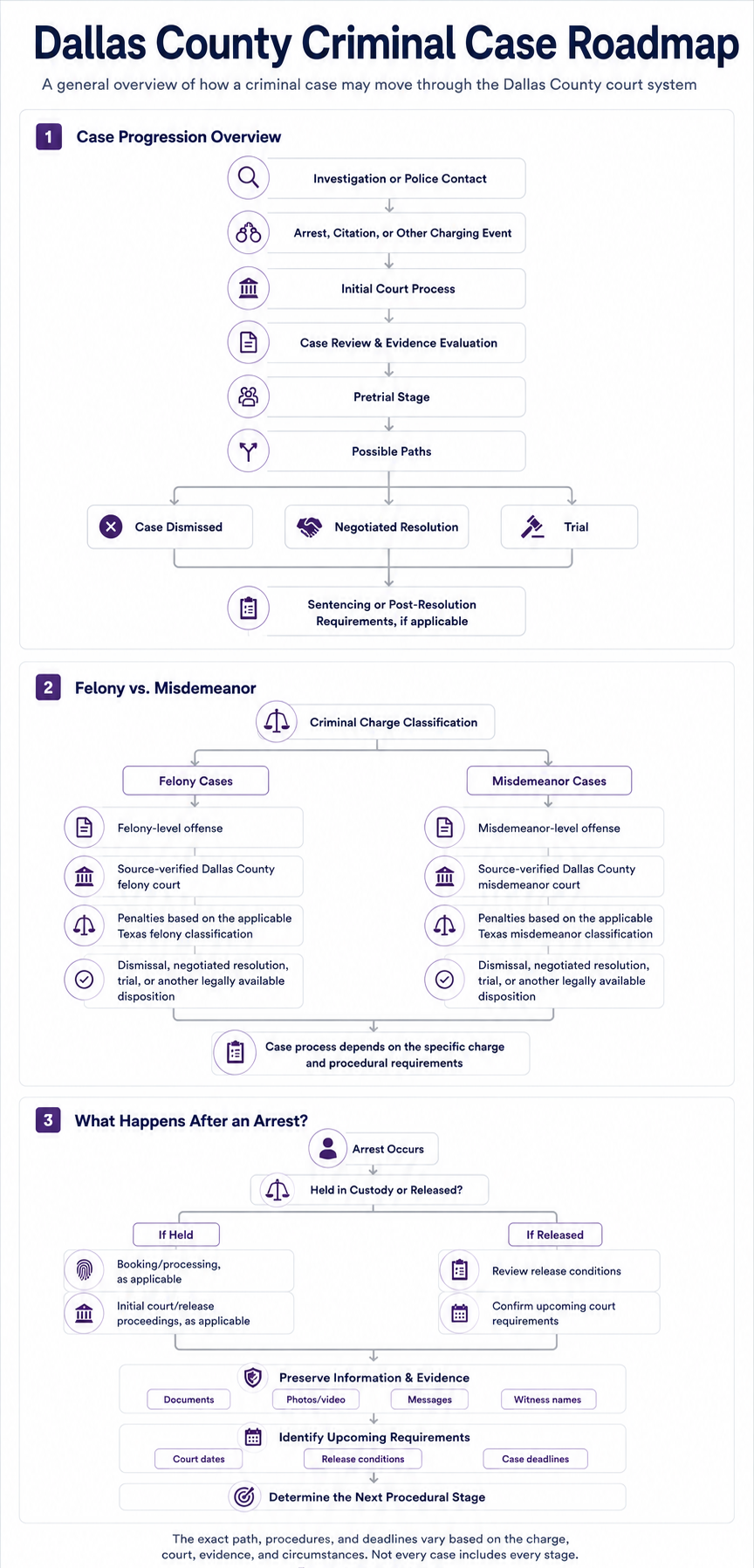
Read this as text
- Framework 1: Dallas County Criminal Case Roadmap
- Investigation or Police Contact
- ↓
- Arrest, Citation, or Other Charging Event (depending on the case)
- ↓
- Initial Court Process
- ↓
- Case Review and Evidence Evaluation
- ↓
- Pretrial Stage
- ↓
- Possible Paths:
- → Case Dismissed
- → Negotiated Resolution
- → Trial
- ↓
- Sentencing or Other Post-Resolution Requirements, if applicable
- The exact path varies based on the charge, court, evidence, and circumstances of the case. Not every case includes every stage.
- Framework 2: Felony vs. Misdemeanor Case Comparison
- Felony Cases | Misdemeanor Cases
- —|—
- Charge Classification: Felony-level offense | Charge Classification: Misdemeanor-level offense
- Court: Source-verified Dallas County felony court | Court: Source-verified Dallas County misdemeanor court
- Potential Penalties: Based on the applicable Texas felony classification | Potential Penalties: Based on the applicable Texas misdemeanor classification
- Case Process: Depends on the specific charge and procedural requirements | Case Process: Depends on the specific charge and procedural requirements
- Resolution: May occur through dismissal, negotiated resolution, trial, or another legally available disposition | Resolution: May occur through dismissal, negotiated resolution, trial, or another legally available disposition
- Framework 3: What Happens After an Arrest — Decision Tree
- Arrest Occurs
- ↓
- Are You Held in Custody or Released?
- If Held:
- → Booking/processing as applicable
- → Initial court/release proceedings as applicable
- If Released:
- → Review release conditions and upcoming court requirements
- Both paths then lead to:
- ↓
- Preserve Relevant Information and Evidence
- → Documents
- → Photos/video
- → Messages or communications
- → Names of potential witnesses
- → Other case-related records
- ↓
- Identify Upcoming Requirements
- → Court dates
- → Release conditions
- → Case-specific deadlines
- ↓
- Determine the Next Procedural Stage
- → Based on the charge, court, and circumstances
- Specific procedures and deadlines depend on the charge, court, and individual circumstances.
Examples Of How This Can Play Out
Example Scenario 1: First-Time DWI Arrest
Situation: Situation:
What Happens Next: A driver with no prior criminal history is stopped in Dallas County on suspicion of driving while intoxicated. The officer reports signs of impairment and conducts field sobriety testing, along with administering a chemical breath or blood test.
Potential Outcomes: What Happens Next:
- The case proceeds through booking or citation issuance depending on the circumstances. The defense and prosecution will review the details surrounding the traffic stop, investigation, and test administration. Questions may arise about the legality of the stop, the reliability of field sobriety tests, and the proper handling and timing of chemical testing.
Factors That Matter:
Situation: What the Facts Could Affect:
What Happens Next: These facts can influence whether evidence is admissible or reliable, what legal defenses may be available, and what resolution paths are appropriate. The evaluation depends on case-specific evidence and procedural compliance, which in turn shape discussions about plea options, diversion eligibility, or trial strategy.
Likely Outcome: These facts can influence whether evidence is admissible or reliable, what legal defenses may be available, and what resolution paths are appropriate. The evaluation depends on case-specific evidence and procedural compliance, which in turn shape discussions about plea options, diversion eligibility, or trial strategy.
- The legal basis and timing for the initial traffic stop
- Officer observations and behavior during the investigation
- Administration and results of any field sobriety tests
- Type and reliability of chemical tests, including chain of custody
- Presence of video evidence such as body-cam or dash-cam footage
- Any medical or environmental factors affecting test accuracy
Example Scenario 2: Aggravated Assault and a Claim of Self-Defense
Situation: Situation:
What Happens Next: An individual faces aggravated assault charges following a physical altercation during a domestic incident in Dallas County. The accused asserts they acted in self-defense.
Potential Outcomes: What Happens Next:
- Prosecutors, defense counsel, and potentially a court or jury will analyze the conflicting accounts and evidence to determine whether the elements of aggravated assault are met and if the self-defense claim satisfies the requirements under Texas law. Merely claiming self-defense does not confirm legal justification.
Factors That Matter:
Situation: What the Facts Could Affect:
What Happens Next: The strength and credibility of evidence impact whether the prosecution can prove the charged offense beyond a reasonable doubt, and whether a self-defense claim can legally negate or mitigate liability. The case’s direction depends on how these issues are factually and legally assessed.
Likely Outcome: The strength and credibility of evidence impact whether the prosecution can prove the charged offense beyond a reasonable doubt, and whether a self-defense claim can legally negate or mitigate liability. The case’s direction depends on how these issues are factually and legally assessed.
- The sequence and nature of events immediately before and during the confrontation
- Statements from the involved parties and independent witnesses
- Physical evidence, including injuries, photographs, or weapon presence
- Video or digital evidence such as surveillance or recorded communications
- Legal criteria for self-defense, including reasonable perception of threat and proportionality
- Prior interactions or history considered only when admissible and relevant under evidentiary rules
Frequently Asked Questions
What are the most common criminal charges filed in Dallas County, TX?
Typical charges in Dallas County include theft, drug offenses, assault (both misdemeanor and felony), DWI, burglary, fraud, and domestic violence. Traffic violations and ordinance offenses also make up a significant portion of docketed cases. Sentencing and court venue depend on the nature and severity of the charge. Each case is fact-specific, so it’s important to understand the particulars of your alleged offense.
How does Dallas County classify misdemeanor vs felony charges?
Dallas County follows Texas Penal Code classifications. Felonies include capital, first-, second-, and third-degree offenses as well as state jail felonies, which are heard in criminal district courts. Misdemeanors fall into Class A, B, or C categories, adjudicated primarily in the county courts at law (Class A and B) or municipal courts (Class C and ordinance violations). The difference is primarily in potential penalties and record consequences.
Where is the Dallas County Jail located for booking and processing?
The Dallas County Jail is located at 111 Commerce St., Dallas, TX. Individuals arrested in Dallas County are typically transported here for booking, fingerprinting, and holding prior to first court appearance. The jail is connected by tunnel to the Frank Crowley Courts Building, streamlining courthouse transport.
How can I find out my bail amount in Dallas County?
Bail is usually set at or shortly after booking. You can find your bail amount by checking Dallas County Sheriff's Office online records, calling the jail, or asking your attorney. In many cases, the initial appearance before the magistrate will confirm or adjust bail and release conditions. Bail amounts depend on the charge, prior record, and perceived flight risk.
Can I get a public defender assigned immediately after arrest in Dallas County?
Yes, if you cannot afford private counsel, you may request a court-appointed attorney at your first appearance. The magistrate or judge evaluates financial need and appoints a Dallas County Public Defender or a local panel attorney. It’s critical to make this request clearly, bring income documentation, and be prepared to explain your financial circumstances.
What are direct and collateral consequences for Dallas County convictions?
Direct consequences include jail or prison, probation, fines, restitution, and mandatory classes. Collateral consequences are less obvious but just as serious—affecting employment, housing, immigration, driver’s licenses, and the right to own firearms. Some collateral consequences last long after legal supervision is complete. Discussing potential impacts with your attorney early is vital.
Do I need a criminal defense lawyer for misdemeanor charges?
While you’re not required to have a lawyer for most misdemeanors, legal representation is strongly advised—even for first-time or minor charges. A defense attorney ensures your rights are protected, advocates for the best outcome, and can often negotiate better terms or argue for case dismissal depending on the facts.
How does Dallas County handle probation violations?
Probation violations are taken seriously in Dallas County. They can result in a motion to revoke probation, which, if sustained, may mean jail or prison time. The court may allow for explanations or modify probation conditions depending on the violation’s nature and the overall compliance history. Legal representation is essential at these hearings.
Are there diversion programs for first-time offenders in Dallas County?
Yes, Dallas County has several diversion programs for first-time, nonviolent offenders. Options include pretrial diversion, conditional dismissal, recovery and treatment courts, and various specialty dockets. Successful completion generally results in case dismissal and, in some instances, ineligibility for public record.
How long after an arrest do I see a judge in Dallas County?
Most defendants appear before a magistrate within 48 hours of arrest. This first appearance covers bail, counsel assignment, and reading of formal charges. Delays are rare but sometimes occur with complex or high-volume cases.
What happens if charges are dismissed—will they appear on my record?
Dismissed charges may still appear on background checks unless sealed or expunged. Eligibility for expungement depends on the specific resolution and whether additional charges remain. Consult your attorney for advice on sealing or expunging dismissed records to minimize long-term impact.
How does Dallas County define burglary and aggravated assault?
Burglary typically means entering a habitation or building without consent, with intent to commit a felony, theft, or assault. Aggravated assault involves causing serious bodily injury or using a deadly weapon. Both are prosecuted as felonies, with heightened penalties and long-term consequences.
If I miss court, can my case be reinstated?
You may be able to address a missed court date by acting promptly—contact the court clerk and an attorney as soon as possible. The court may quash the warrant and reschedule, but repeated no-shows reduce your chances. Immediate action preserves the best defense options.
Who prosecutes Dallas County felony and misdemeanor charges?
Felony cases are prosecuted by the Dallas County District Attorney’s Office; misdemeanors by assistant district attorneys or city prosecutors for ordinance violations. These offices also oversee grand jury proceedings and negotiate pretrial diversion or plea agreements.
How often do DUI/DWI charges occur in Dallas County?
DWI is among the most charged offenses in Dallas County. Law enforcement regularly conducts sobriety checkpoints and aggressive traffic enforcement. Many DWI cases are handled as Class B or Class A misdemeanors, with repeat or aggravated cases prosecuted as felonies.
Can I handle a Dallas County criminal case without a lawyer?
While the law allows self-representation, it’s not recommended except for the most minor offenses. Criminal cases involve complex rules and procedures. Even procedural mistakes can harm your future. Consulting a defense attorney is the safest way forward.
How can a lawyer help reduce charges in Dallas County criminal courts?
An experienced criminal defense lawyer can negotiate with prosecutors for reduced charges, secure plea deals, challenge unlawfully obtained evidence, or direct your case toward alternative outcomes such as diversion. Early legal intervention often leads to better results.
Are juvenile records handled differently in Dallas County?
Yes, juvenile cases are processed in separate courts under different procedures. Records are not always public, and the focus is often on rehabilitation instead of punishment. However, serious juvenile offenses can have long-lasting consequences and may sometimes be certified to adult court.
What are my rights during a Dallas County arrest?
You have the right to remain silent, to request an attorney, to know the charges against you, and to a prompt judicial appearance. You may refuse to consent to searches except in legally justified circumstances. Exercise your rights respectfully and clearly to protect your case.
Can victims request protective orders in Dallas County courts?
Yes, victims of threats, violence, or harassment may petition for protective orders through Dallas County civil or criminal courts. These orders can impose contact, communication, and firearm restrictions on the accused—sometimes immediately after a criminal complaint is filed.
Key Takeaways
- The classification of a criminal charge as a misdemeanor or felony in Dallas County determines the potential penalties, the court with jurisdiction, and the applicable procedural rules. This classification influences how the case will be processed and the seriousness of consequences involved.
- The procedural path of a Dallas County criminal case is not uniform; it varies based on the specific offense, the level of the charge, evidentiary factors, and the unique circumstances surrounding the case. Steps such as booking, bail hearings, discovery, or grand jury review may occur depending on these factors rather than being universal.
- Legal and evidentiary issues in a case—such as the lawfulness of police conduct, the credibility of witness statements, and the admissibility of physical or digital evidence—play a critical role in how a case is evaluated and how it proceeds through the Dallas County criminal justice system.
- Court attendance requirements are essential in Dallas County criminal proceedings. Failure to appear as required can lead to additional legal challenges, including possible issuance of arrest warrants or modifications to release status; however, consequences depend on verified judicial decisions and circumstances.
- The range of possible case resolutions in Dallas County depends on numerous factors, including the type of charge, the evidence available, relevant legal standards, procedural posture, and any applicable statutory eligibility rules. Case outcomes vary and are shaped by these complex, case-specific elements.
Related Reading
- Criminal Defense in Texas
- Types of Criminal Charges
- Arrest, Booking, and Bail Process
- Legal Representation and Defense
- Sentencing, Probation, and Alternatives
- Criminal Records, Expungement, and Sealing
- Dallas County DWI Defense
- Dallas County Drug Crimes Defense
- Domestic Violence and Protective Orders in Dallas County
- Juvenile Criminal Defense in Dallas County
Take Control of Your Dallas County Criminal Case Now
Every step taken today can influence the outcome of your Dallas County criminal matter. Whether facing investigation, already charged, or navigating court appearances, your future may be at stake. Get guidance specific to your charge and circumstances—consult a local defense attorney who can evaluate your case and protect your rights from the very start.
Get a Dallas County Defense Evaluation